
Expert Pool Table Leveling
Even a small leveling problem can affect ball movement, speed and consistency. Pool Table Masters uses precision machinist levels to evaluate the actual slate playing surface—not just the cabinet or frame.
Signs Your Pool Table May Need Leveling
Ball Roll
Balls consistently drift to one side, curve at slow speed, or play differently from one end of the table to the other.
Table Movement
The cabinet rocks, the table was recently moved or reassembled, or slate seams have shifted or become noticeable.
Floor Changes
Carpet, padding, rubber tiles, floating flooring or another surface beneath the table has compressed, settled or changed.
A table can look level while still having small variations across the playing surface. Slow-moving balls often reveal problems that are difficult to see by eye.

Why a Machinist Level Matters
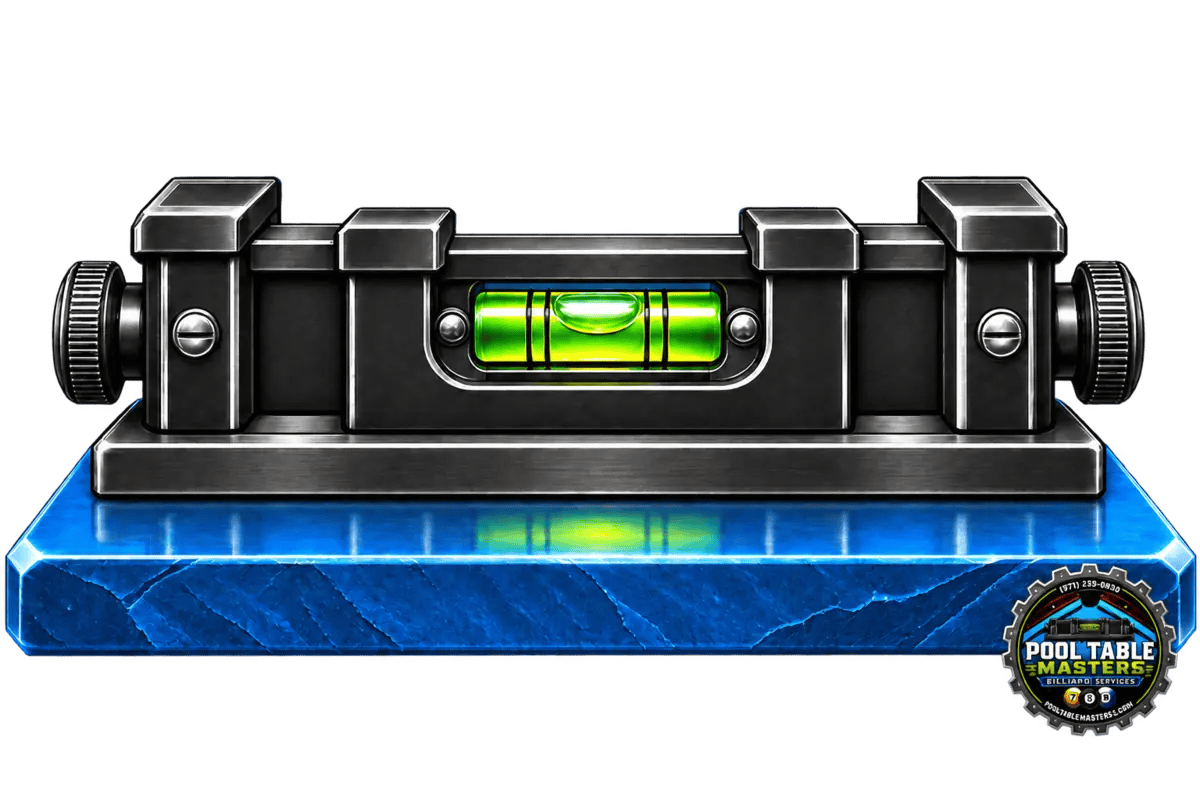
Standard carpenter levels are useful for construction, but pool-table work benefits from a much more sensitive instrument. PTM uses precision machinist levels to detect very small variations across the slate.
The playing surface is checked lengthwise, across its width and at multiple points around the slate. Adjustments are based on the surface the balls actually roll on.
Cabinet vs. Slate
Leg adjustments can correct the general position of the cabinet, but they cannot always correct differences between slate sections, frame support, seam alignment or localized high and low areas.
Three-Piece Slate Requires Additional Precision
On a three-piece slate table, each section must be evaluated individually and in relation to the adjoining sections. The seams need to align so the completed playing surface behaves as one continuous plane.
Improper support can create uneven ball roll, raised seams, low spots or movement after the table has been recovered. Proper installation combines slate leveling, seam work and stable support beneath the slate.
More Than Adjusting the Legs
Some problems can be corrected through careful leg adjustments. Others require access to the slate and supporting frame. The right correction depends on table construction, frame condition, slate configuration and where the unevenness is located.
What Can Cause a Pool Table to Become Unlevel?
Movement & Assembly
- Moving or bumping the table
- Improper assembly
- Loose hardware
- Slate seam movement
Frame & Support
- Frame movement
- Inadequate slate support
- Changes beneath a table leg
- Cabinet settling
Floor & Building
- Carpet or padding compression
- Rubber/interlocking tile settling
- Floating-floor movement
- Seasonal building changes
Flooring Can Change After the Table Is Leveled
A pool table is extremely heavy. Softer or floating floor systems can compress or settle after the table has been installed, which can change the table’s level even when it was accurately leveled at installation.
For more planning information, see Game Room Planning and Service Policies.
When Should Leveling Be Checked?
Precision leveling should be checked whenever a pool table is assembled or reassembled, moved, recovered, having slate-seam work performed, receiving significant rail/cushion service, or showing signs of uneven ball roll.
After a Move
Disassembly and relocation change the table’s relationship to its frame and floor. Leveling is a critical part of proper reassembly.
During Refelting
When slate is accessible, it is a good opportunity to check support, seams and level before new cloth hides the playing surface.
When Play Changes
If slow balls consistently drift or a previously accurate table begins playing differently, the slate and supporting environment should be evaluated.
Related services: Pool Table Moving & Installation and Pool Table Refelting.
Precision You Can Play On
Pool Table Masters evaluates the complete playing surface before determining what adjustment is appropriate. The goal is not simply to make a bubble look centered—it is to create a stable, consistent playing surface.
Precision leveling is available throughout the Portland metropolitan area and across Oregon and Washington as part of installation, repair, refelting and standalone service when appropriate.

Is Your Pool Table Rolling Off Line?
Tell us what the table is doing, where it is located and whether it has recently been moved, serviced or installed on new flooring.